Sports data analytics
From sensor data to race-winning decisions
We turn SailGP's raw, multi-channel telemetry — and hours of race commentary — into decision-ready insight, and into the tools that put that insight directly in the hands of sailors, coaches and performance engineers.
Confidential: the SailGP engagement is private. This page describes the method only, in general terms — no client data, results, or team-specific figures are reproduced.
The challenge
A SailGP F50 generates dense multi-channel telemetry — roughly 400 sensor channels at 10 Hz, across boat speed, loads, attitude, wind, and foil and rig geometry — for every boat, every race, every regatta. Alongside it sits a second, unstructured source of knowledge: hours of race commentary and analysis, where sailors and analysts say in words what the sensors only measure in numbers. Neither was usable as-is. The telemetry was too large and too raw for a coach to query directly, and the tactical knowledge in the commentary was locked inside video, unsearchable and disconnected from the data it explained.
What we did
- Built data pipelines on a medallion architecture (bronze → silver → gold) to turn raw multi-channel telemetry into clean, labelled, analysis-ready datasets.
- Performed insight extraction — manoeuvre-cost modelling, ideal-line and routing analysis, and start-line analysis — turning labelled telemetry into the performance metrics that matter to sailors and coaches.
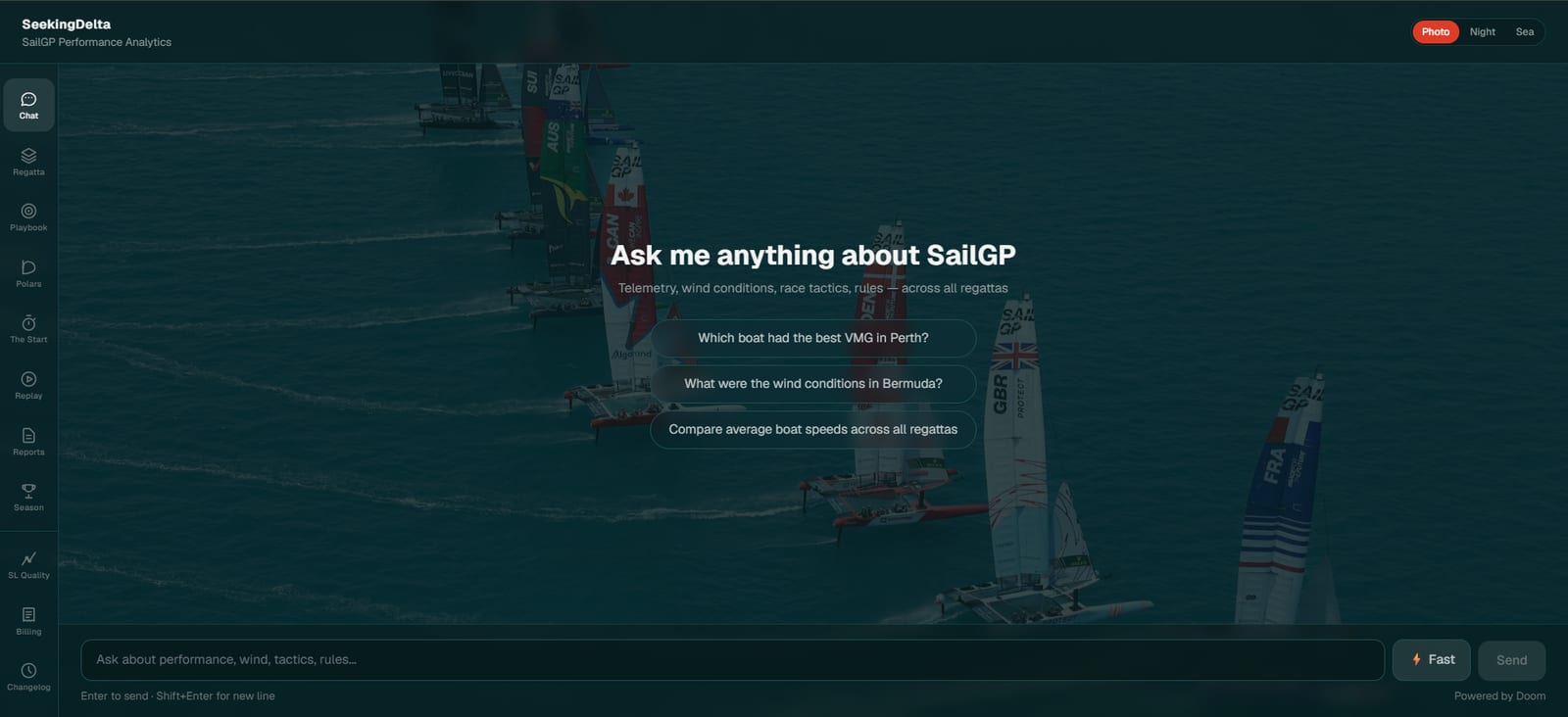
- Developed an interactive dashboard and a multi-agent AI system that answers concrete questions about performance and tactics by querying both the telemetry and a curated knowledge base built from race commentary.
Approach
1 — Data pipeline
Raw telemetry moves through three layers, each a deliberate, narrow step rather than one monolithic transform. Bronze turns raw sensor files into a queryable format with no business logic applied. Silver is where domain knowledge enters: sensor smoothing, and manoeuvre detection that labels every tack, gybe and mark rounding directly from the signal, splitting each race into numbered straight-line and manoeuvre segments. Gold aggregates silver into race-, leg- and event-level summary tables — the layer both the dashboard and the AI system reach for first, so most questions are answered from a small, pre-computed table rather than a scan over raw signal.
2 — Insight extraction
Labelled telemetry is only the raw material; the harder problem is turning it into performance metrics that hold up under scrutiny. We built a manoeuvre-cost model that measures what a tack, gybe or rounding actually costs in progress toward the mark — not just boat speed retained through the turn, which turns out to tell a different, sometimes contradictory story. On top of that sits an ideal-line model: calibrated boat performance, a reconstructed wind field, and the manoeuvre-cost model combine into a routing optimiser that reconstructs the fastest way a leg — or a full course — could have been sailed, validated against how the fleet actually performed before being trusted for anything drawn on screen. A parallel line of work applies the same rigour to the pre-start: modelling the approach to the line and the value of starting position.
3 — Interactive tools & AI system
The dashboard puts this analysis in front of sailors and coaches directly — race replay with a modelled “ideal line” alongside the boats that actually sailed it, and a performance cockpit for scoring how closely a boat is sailed to its targets. Layered on top is a multi-agent AI system: a master agent delegates to specialist sub-agents for telemetry, for the knowledge base, and for web search, each returning a short, distilled answer rather than raw rows — keeping the expensive reasoning model's context small and the whole system fast and affordable to run. The knowledge base itself is built from race commentary, structured and embedded for semantic search, so a question is answered with a citation back to what was actually said, not just a number.
Outcome
The result is a live platform sailors, coaches and analysts use to get straight, sourced answers during debriefs and race weeks, instead of waiting on manual analysis. It is under active, iterative development, shaped directly by feedback from the coaches and sailors who use it.