Quality & certification
Engineering Olympic-grade quality assurance
When Formula Kite entered the Olympic Games for the first time at Paris 2024, manufacturers had to prove every production hydrofoil met exceptionally demanding dimensional, functional and production-quality requirements. Flying Sardine, a Portuguese high-performance hydrofoil manufacturer, partnered with Lume to engineer the complete quality-assurance framework required for Olympic equipment certification.
The challenge
The International Kiteboarding Association (IKA) and World Sailing introduced an extensive certification programme to guarantee that every Olympic hydrofoil was manufactured consistently, for a fair and level playing field. The dimensional requirements were exceptionally demanding — many critical characteristics controlled to ±0.5 mm. Measuring large carbon-composite foils to that precision is hard: residual stresses from curing cause spring-back once a part leaves the mould, so a foil’s free-state shape isn’t its assembled shape. Flying Sardine needed a quality-control system robust enough for 100% production inspection, yet rigorous enough to withstand independent international audits.
What we did
- A complete production QC methodology, from incoming inspection through to final certification.
- A functional GD&T strategy built on datum systems representing the real assembly condition, plus four precision CNC-machined inspection fixtures covering two foil families and two mast geometries.
- Statistical qualification of the entire measurement system — Cg/Cgk, MSA, Cm/Cmk and Cp/Cpk studies — plus visual inspection via Limit Sample Cards and functional tests for weight, centre of gravity and stiffness.
Approach
1 — Functional measurement datums
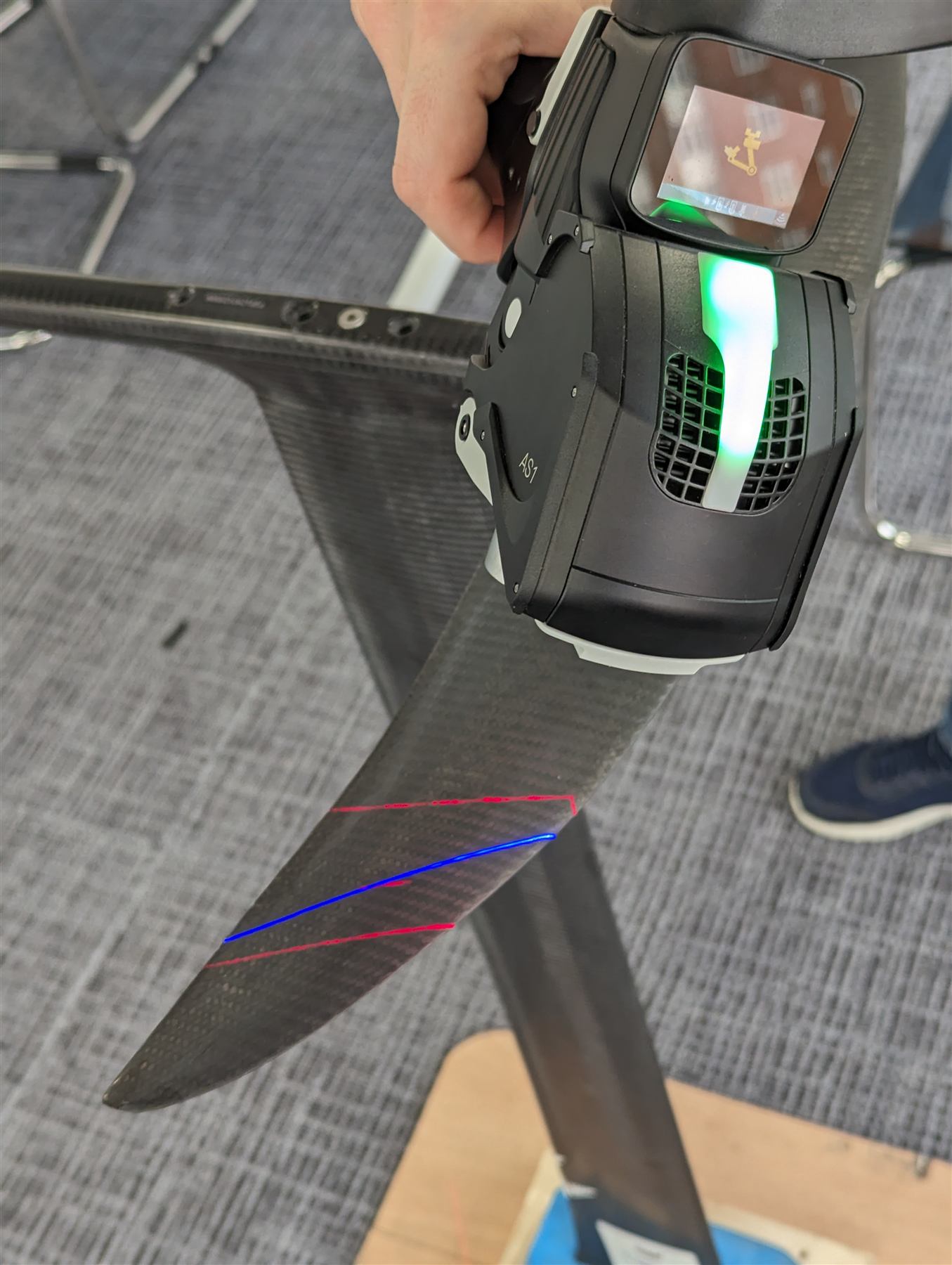
Instead of measuring free-state composite parts, we constrained every foil exactly as it would be assembled to the mast and board. That single decision turned a difficult composite geometry — one that moves as soon as you unclamp it — into a repeatable, GD&T-based inspection process.
2 — Engineering the metrology system
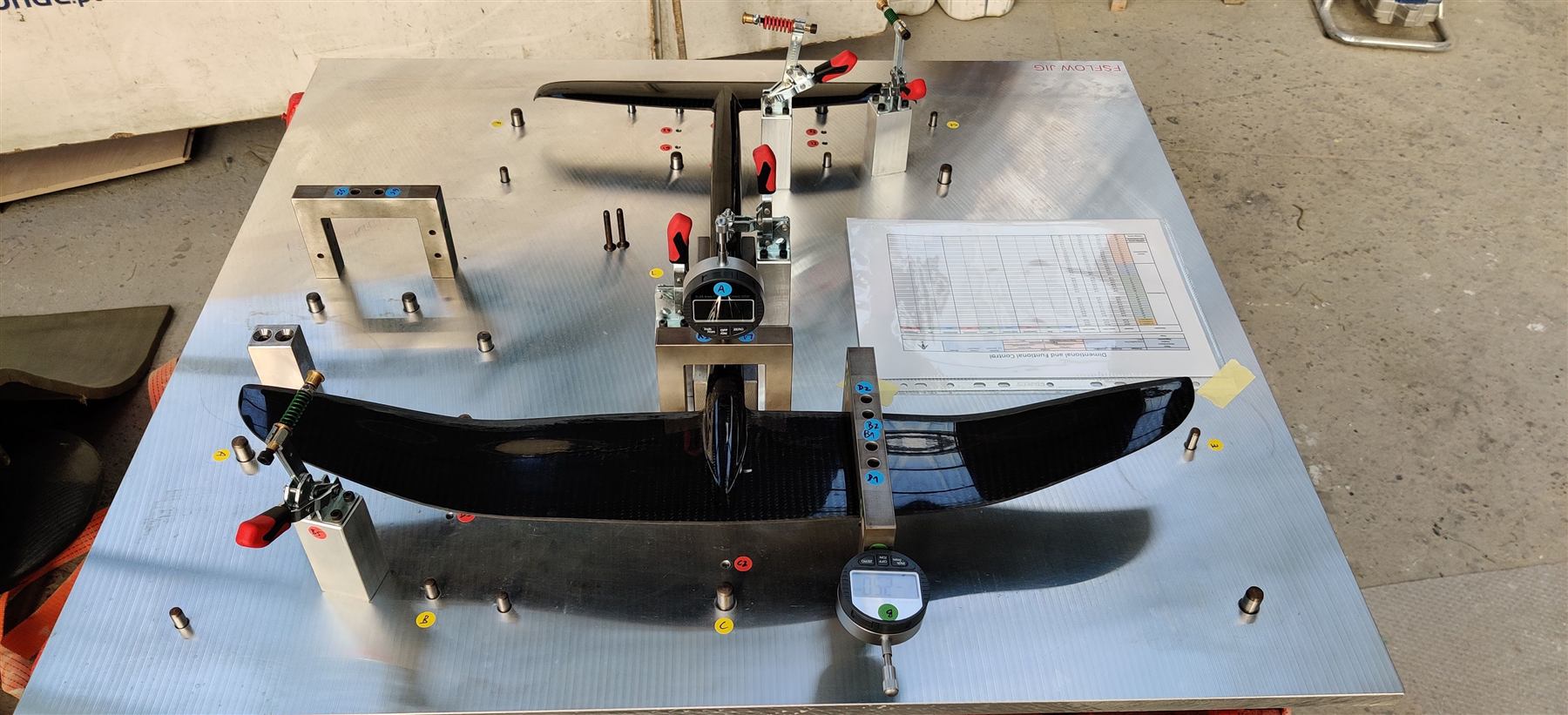
We combined datum definition, fixture design, calibrated gauges, automated calculations and reporting into a single traceable inspection workflow — not a set of isolated measurement tools. Each of the four fixtures locates a foil on its functional datums, holds it under spring-loaded clamps, and reads dimensional deviation straight off dial and digital gauges at labelled datum points.
3 — Proving the measurement system
A jig is only as good as the evidence that it measures correctly. Every gauge and the complete inspection process were statistically validated — Gauge Capability (Cg/Cgk), Measurement System Analysis, operator-to-operator reproducibility, and production capability studies (Cm/Cmk, Cp/Cpk) — before the system was trusted for 100% inspection.
4 — Beyond dimensional inspection
Dimensions alone don’t certify a foil. We added visual inspection using automotive-style Limit Sample Cards — physical reference standards for pinholes, porosity and laminate defects — and functional tests for weight, centre of gravity, and longitudinal and torsional stiffness, accounting for the natural variability of wet-laminated composite construction.
5 — International audit support
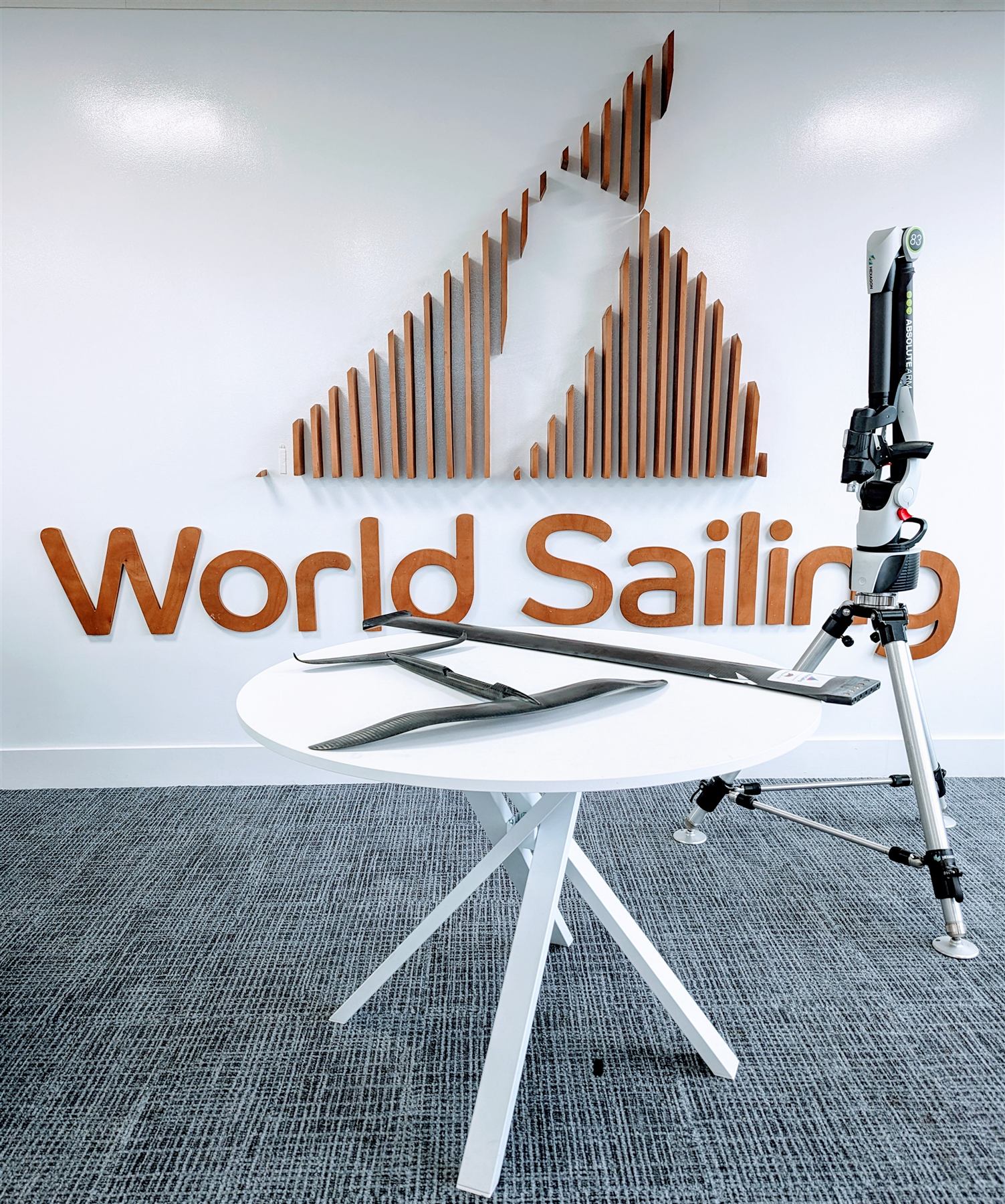
Lume prepared the technical documentation, protocols and reports used during IKA and World Sailing audits. For LA2028, we travelled to World Sailing’s London headquarters to align our functional, jig-based measurement methodology with their new 3D-scanning verification process.
Outcome
The quality-control framework was recognised as best-in-class during the Olympic certification programme and became the reference methodology for Flying Sardine’s production. It delivered Olympic certification for Paris 2024, registration support for Los Angeles 2028, 100% traceable production inspection, consistent measurement of complex composite structures, and a successful alignment between functional jig-based inspection and World Sailing’s new 3D-scanning process. Flying Sardine remains a certified Olympic equipment manufacturer, supported by the engineering quality system Lume built.